The week integration became the new scale.
The headlines weren't about bigger data centers or new chips — they were about convergence. AI, security, and observability finally started merging into one fabric.
The new competition isn't "who scales fastest" — it's "who connects best."
🌩 This Week's 3 Signals
1. Nvidia licenses Groq tech and deepens AI leadership (Dec 24)
Nvidia secured a major licensing deal with AI chip startup Groq, bringing inference IP and key engineers in-house without a full acquisition — a $20 billion move reshaping the AI compute race.
Why it matters:
Cloud hardware now follows a "federated performance" model — integrating diverse inference engines instead of betting on one silicon.
Action to be taken: In Cloudshot, tag workloads that depend on proprietary GPU ops vs open inference tech. See how flexible your architecture is if the compute mix shifts mid-year.
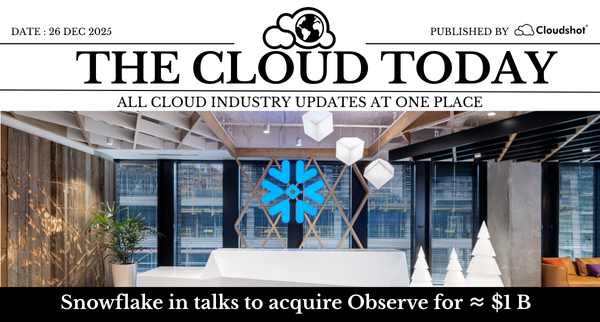
2. Snowflake in talks to acquire Observe for ≈ $1 B (Dec 26)
Snowflake is negotiating to buy Observe, an AI-driven observability platform, to expand into real-time cloud telemetry and incident intelligence.
Why it matters:
Observability is no longer a DevOps niche — it's becoming the control layer linking performance, cost, and compliance.
Action to be taken: Connect observability signals to FinOps dashboards in Cloudshot so latency spikes and cost anomalies appear as one story, not separate alerts.
3. Google Cloud × Palo Alto Networks expand $10 B AI security deal (Dec 19)
Google Cloud and Palo Alto Networks announced a multi-billion-dollar partnership to embed AI-driven security controls directly into GCP services.
Why it matters:
The boundary between platform security and AI automation is disappearing. Threat detection is shifting from manual dashboards to autonomous defense systems.
Action to be taken: Review how your IAM and XDR data integrate with native AI signals. Simulate a multi-cloud attack path and see if your visibility actually crosses providers.
💡 Cloudshot Tip of the Week
Treat integration as a resilience metric. In Cloudshot, map how cost, security, and observability connect through shared data flows.
Resilience isn't about uptime anymore — it's about how fast systems see and react to each other's signals.
🗓 What We Published This Week
Dec 22 (Mon) — Organizations break before infrastructure does — the cloud memory deficit.
Why historical context, not compute, is what keeps systems resilient. → Full Article
Dec 23 (Tue) — Holiday deploys expose one truth: nobody owns the full historical context of infra.
How missing institutional memory turns simple changes into surprise incidents. → Full Article
Dec 24 (Wed) — Demo: Unified change-story builder — incident causality in one visual narrative.
A live demo of Cloudshot's change-mapping that turns chaos into clarity. → Full Article
🔭 Strategic Signal
The cloud story is pivoting from expansion to connection.
Every major move this week — Nvidia's licensing, Snowflake's observability push, Google's AI-security fusion — points to a singular truth: the next advantage is architectural coherence.
Whoever links the most systems wins the most visibility.
⚠️ Before It Happens to You…
Integrate your data streams before your teams start guessing from separate dashboards.
Context loss is the new outage.
The Cloud Today turns a week of AI and cloud shifts into a 2-minute briefing, so your leadership doesn't spend hours guessing what actually mattered.
Two minutes now. Months of misaligned roadmaps avoided later.