
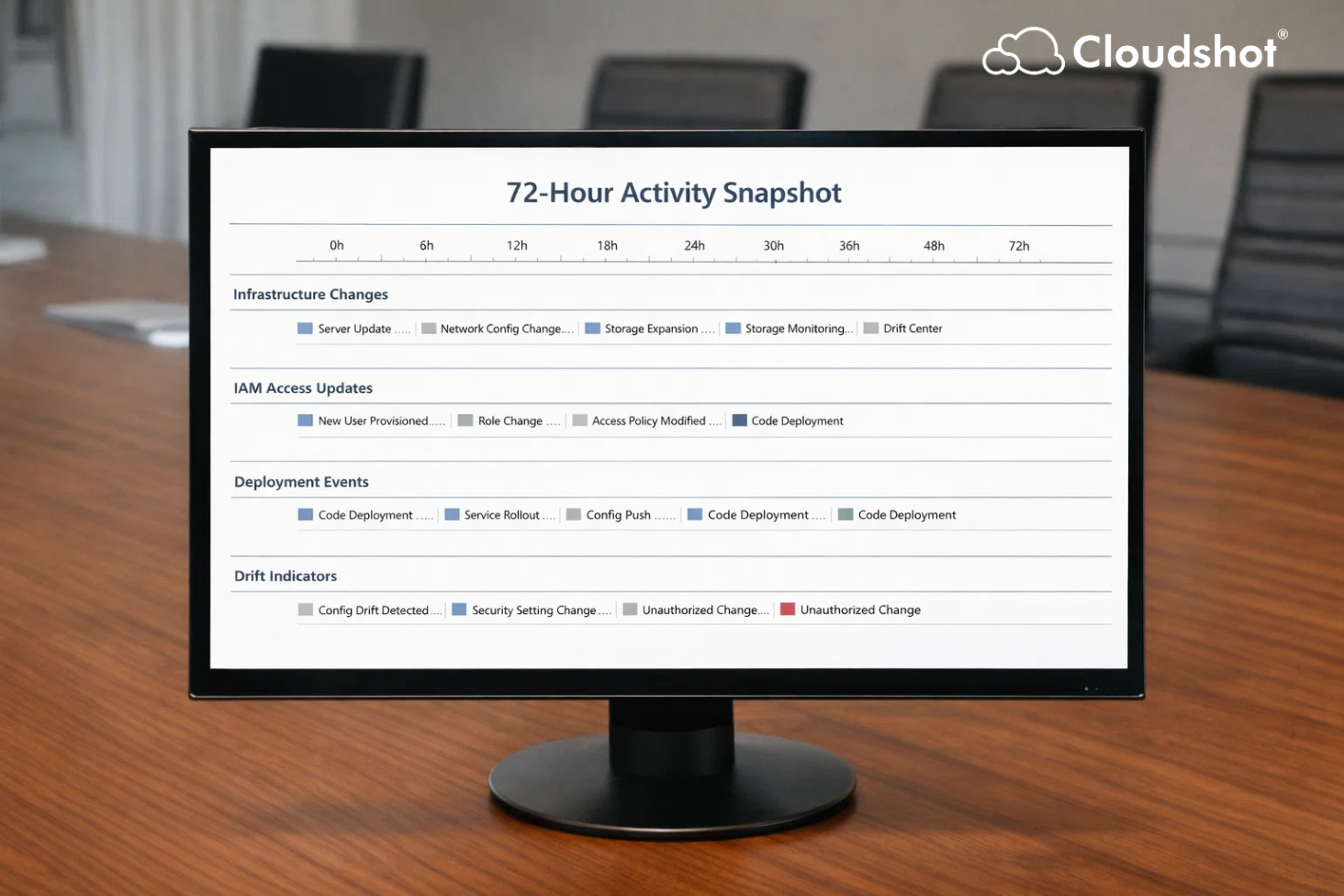
Audit preparation often feels disproportionate to the question being asked.
"Show us what changed recently."
The request is simple.
The response rarely is.
Cloud environments generate enormous activity streams across infrastructure, identity, deployment pipelines, and SaaS integrations. Every modification leaves a log entry. Every access change is recorded somewhere.
Yet when auditors request a recent-change summary, teams scramble.
Security exports IAM reports.
DevOps gathers deployment logs.
Architects document infrastructure updates.
Compliance teams attempt to summarize it all into something readable.
The issue is not data availability.
It is data consumability.
Why Raw Logs Create Audit Friction
Logs are comprehensive. They capture exact timestamps and technical context.
But they are not structured for external review.
Auditors require clarity:
What changed?
Who initiated it?
What systems were affected?
Were any controls bypassed?
Did drift occur?
When answering these questions requires switching between tools and reconciling timestamps, the process becomes manual.
Manual assembly introduces delay.
Delay introduces uncertainty.
And uncertainty erodes confidence in governance.
The 72-Hour Window
Most audit checkpoints focus on recent activity. The last 24 to 72 hours often represent the highest scrutiny window.
This is where teams must demonstrate:
Controlled deployment practices
Traceable IAM modifications
Clear approval chains
No unauthorized drift
In traditional environments, compiling this evidence means exporting multiple reports and stitching them into a narrative summary.
That stitching step is the hidden cost.
From Evidence Gathering to Snapshot Clarity
An effective audit snapshot should:
Consolidate infrastructure changes
Highlight IAM updates
Surface deployment events
Show cross-account modifications
Identify drift signals
Connect each change to ownership context
It should be exportable in a structured, readable format.
Not a dashboard screenshot.
Not raw JSON.
A human-readable, governance-ready summary.
Cloudshot's Free Audit Readiness Snapshot delivers exactly that.
Instead of navigating separate tools, teams generate a unified 72-hour change view.
Auditors see structured sequences rather than fragmented logs.
Security teams spend less time translating.
Compliance teams spend less time reconciling.
Executives gain confidence that governance is not reactive.
A Practical Example
Imagine an auditor reviewing access changes in the past three days.
Without consolidation, the team must check IAM logs, cross-reference deployment pipelines, and confirm whether any infrastructure adjustments altered permissions.
With a 72-hour snapshot, those events appear within one readable timeline:
An IAM group modification
A related deployment
A configuration adjustment
Confirmation that controls remained intact
Instead of reconstructing events, the team reviews them.
The difference is preparation versus assembly.
Governance as Ongoing Discipline
Audit readiness is not an event.
It is an operating posture.
When recent activity can be reviewed instantly and exported cleanly, governance shifts from reactive documentation to continuous oversight.
Teams stop fearing the question, "What changed?"
They are prepared to answer it.
And clarity is what governance ultimately demands.