
Access control failures rarely begin with deliberate mistakes.
They form quietly, through layers of inherited permissions that no one fully tracks.
In modern cloud environments, IAM complexity grows faster than teams realize. Groups are created for projects. Roles are added for migrations. Temporary access becomes permanent. Over time, the system accumulates access pathways that no one intended to design.
When an audit arrives, this hidden structure becomes visible.
The Real Problem: Permission Chains Nobody Owns
Security teams often believe policies are well defined. Architects assume role hierarchies are structured. DevOps trusts that access follows operational need.
But IAM rarely remains static.
A simple example:
A contractor is added to a project group.
That group inherits a role with read access to billing data.
Later, the contractor transitions internally.
The group membership remains unchanged.
Now, access persists long after its purpose has ended.
No policy violation occurred.
No alert fired.
No malicious activity happened.
Yet exposure widened.
In more complex cases, nested groups inherit from other groups. Permissions propagate across accounts. A change made for one environment extends unintentionally into another.
When someone asks, "Who can access this resource?" the answer becomes conditional. It depends on inherited chains, historical changes, and context buried in logs.
This is where audits become stressful.
The Agitation: Why Logs Are Not Enough
IAM logs show actions.
Policies show configurations.
Neither shows how access evolved.
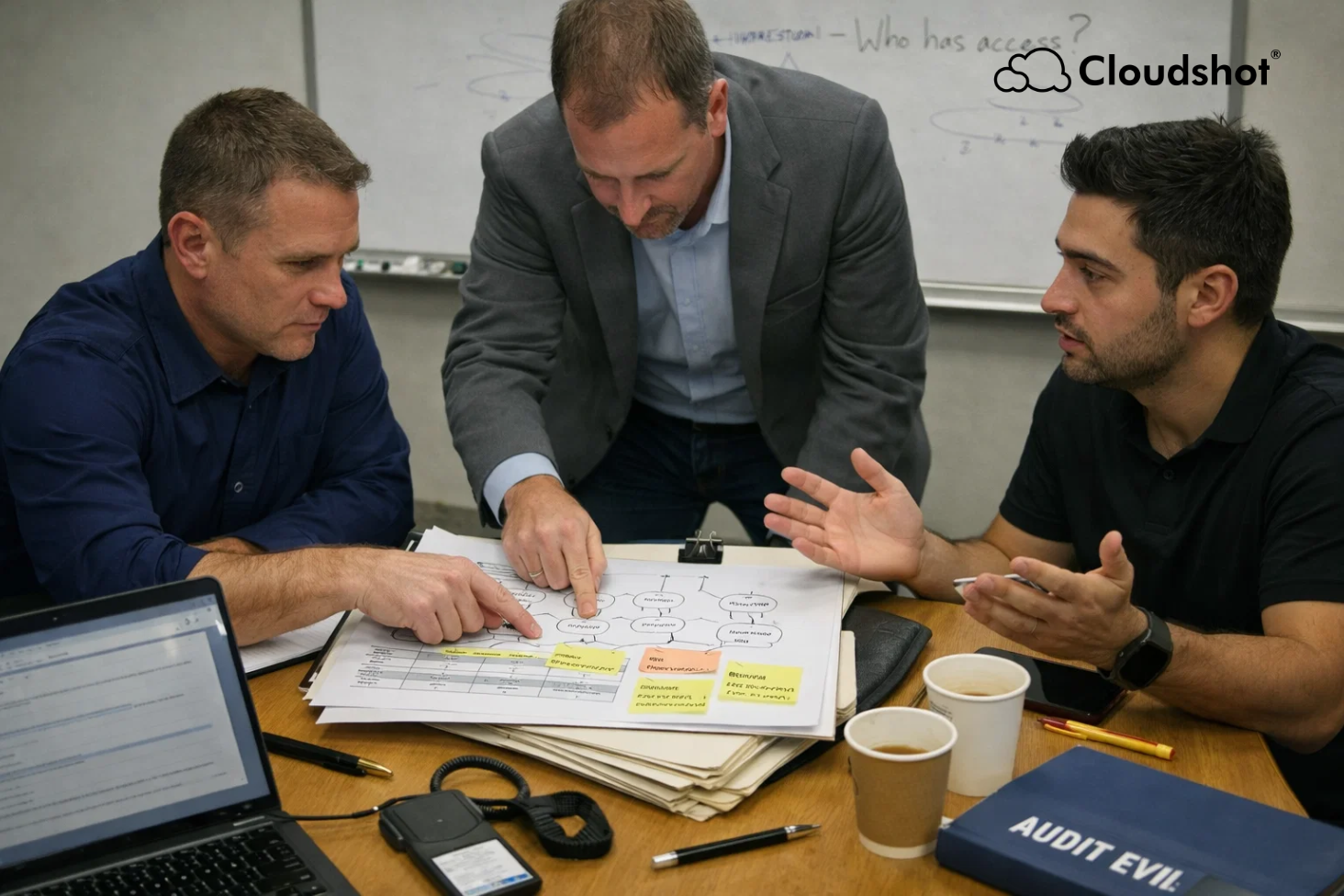
During a compliance review, teams manually trace group hierarchies. They cross-reference timestamps. They compare policy versions.
This process is slow and fragile.
Security argues for tighter controls.
Engineering explains operational constraints.
Compliance asks for a clear narrative.
Without a shared access timeline, decisions stall.
The risk is not always breach.
The risk is uncertainty.
And uncertainty during an audit creates operational tension.
The Solution: Reconstructing Access as a Story
Cloudshot reframes IAM governance by focusing on historical clarity.
Instead of viewing permissions as static configurations, it reconstructs them as change narratives.
Security and architecture teams can see:
when a group was created
how roles were attached
when inheritance expanded scope
where access drifted beyond original intent
This visibility shifts the conversation.
Rather than debating current exposure, teams can trace how it formed. That traceability enables faster remediation and stronger preventive governance.
The goal is not to generate more alerts. It is to create shared understanding across teams.
When access chains are visible, ownership becomes clear.
A Practical Scenario
A cloud architect prepares for a quarterly audit. Billing data appears accessible to more users than expected. Instead of manually reviewing policy trees, the team uses a visual permission timeline.
Within minutes, they identify a nested group created during a migration. The group was never cleaned up.
The issue is resolved before the audit review begins.
No scramble.
No cross-team tension.
Just clarity.
Moving Forward
Hidden IAM chains are not rare edge cases. They are structural outcomes of growing cloud environments.
The solution is not stricter policies alone.
It is historical visibility into how access evolves.