
Multi-cloud architecture rarely fails because teams lack skill.
It fails because visibility fractures at the boundaries.
Each cloud provider offers its own monitoring tools. Its own network maps. Its own configuration layers. Architects can view AWS resources inside AWS, Azure services inside Azure, and GCP infrastructure inside GCP.
But cross-cloud relationships often remain implicit.
And implicit relationships are fragile.
The Static Diagram Problem
Most architecture diagrams are snapshots.
They reflect a point in time.
They capture intended design.
They rarely capture drift.
In multi-cloud environments, change velocity is high.
Services are added.
Traffic routes shift.
IAM roles evolve.
Autoscaling policies adjust behavior.
When diagrams are updated manually, they lag reality.
During incidents or performance reviews, this gap becomes visible.
Teams rely on outdated topology representations while the system has already changed.
The question shifts from "Where is the issue?" to "Is this map still correct?"
That uncertainty slows analysis.
Cross-Cloud Dependency Complexity
Multi-cloud environments introduce unique challenges:
Cross-provider API calls
Hybrid identity flows
Shared databases accessed from different regions
Failover mechanisms spanning platforms
When one service degrades in Azure, the originating trigger may exist in AWS.
When traffic shifts inside GCP, the upstream cause might sit in another provider.
Without unified dependency mapping, tracing these paths requires manual investigation across consoles.
Architects must:
Switch between dashboards
Reconcile service IDs
Confirm connection paths
Validate traffic routes
Each step adds friction.
From Provider Views to Unified Topology
True multi-cloud visibility requires abstraction above the provider layer.
Instead of viewing AWS, Azure, and GCP separately, teams need a continuous topology.
A unified dependency map answers:
Which services depend on this node?
What upstream systems feed into it?
How does traffic flow across providers?
What would break if this node changed?
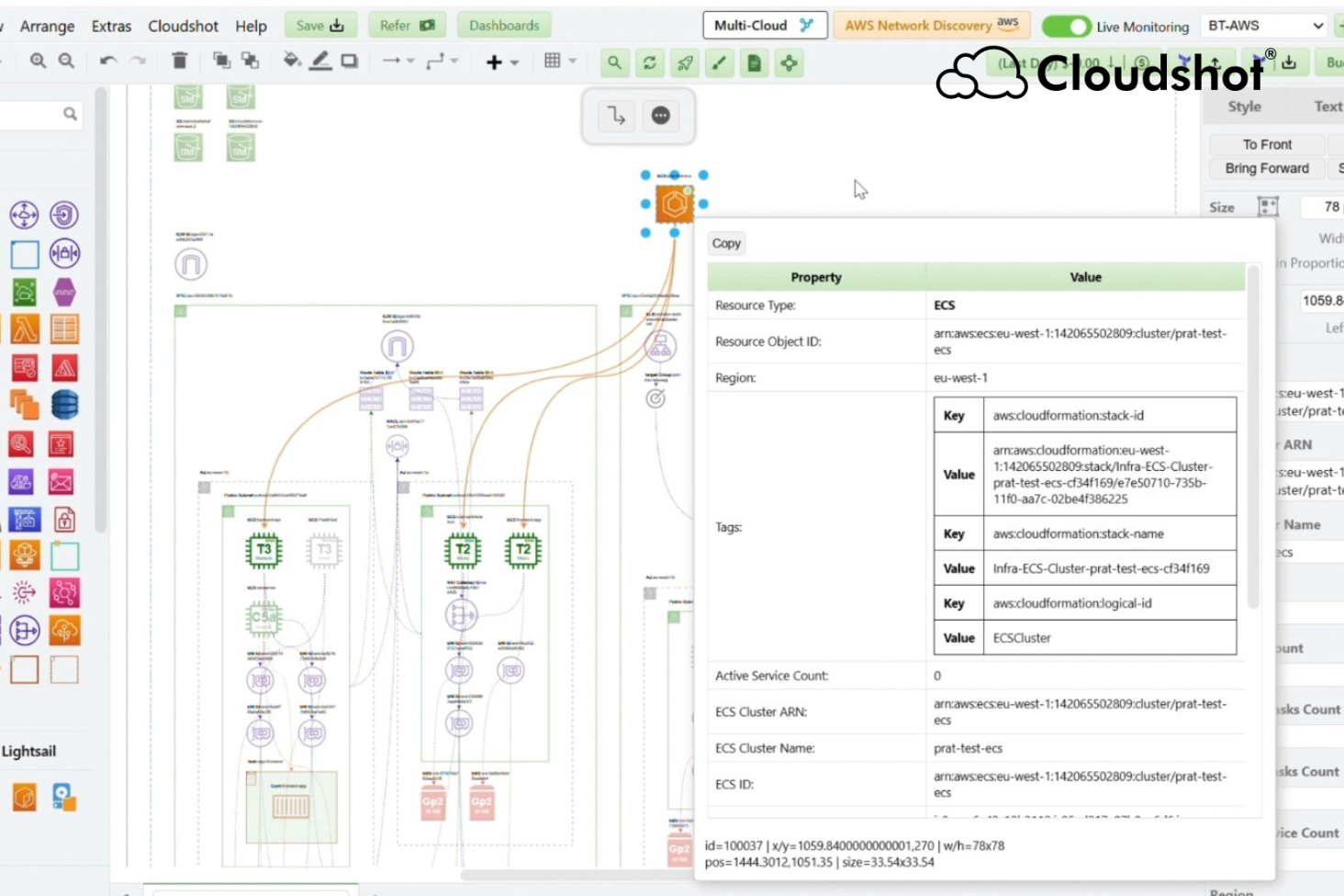
Cloudshot's Live Dependency Mapping reconstructs cross-cloud relationships in real time.
It maps infrastructure connections across providers and overlays them into a single visual architecture.
Architects can select any node and instantly view:
Upstream dependencies
Downstream impact paths
Cross-cloud traffic relationships
Service interaction layers
The value is not aesthetic.
It is operational.
A Practical Example
Imagine a latency spike in a GCP-hosted service.
Without cross-cloud mapping, teams review GCP metrics first. They see normal infrastructure utilization. They escalate. Later, they discover an upstream AWS service changed its retry configuration, increasing cross-cloud call volume.
With a live unified map, that relationship is visible immediately.
Instead of troubleshooting each cloud in isolation, teams investigate within context.
This shortens resolution time.
And more importantly, it reduces misdirected analysis.
Architecture That Reflects Reality
Multi-cloud strategy is about flexibility.
But flexibility without unified visibility increases cognitive load.
Live dependency mapping reduces that load.
It restores architectural coherence across providers.
It aligns DevOps, Architects, and Security teams around one shared topology.
And it transforms diagrams from static documentation into operational tools.
When architecture reflects reality in real time, cross-cloud drift becomes visible before it escalates.