
Most cost investigations begin too late.
The invoice lands. Finance flags a spike. Engineering starts retracing steps. Meetings are scheduled. Screens are shared. Assumptions are debated.
By then, the change is already live.
Cloud cost surprises rarely originate in Finance. They originate in code decisions made days or weeks earlier. A scaling rule adjusted. A new dependency introduced. A configuration change merged without understanding its runtime implications.
The problem isn't intent.
It's visibility at the moment of decision.
The Operational Gap Between Merge and Invoice
In most organizations, deployment discipline is mature. Pull requests are reviewed. Tests are automated. Security scans run before merge.
But cost rarely gets the same treatment.
Engineering evaluates performance impact.
Security evaluates exposure.
Very few teams evaluate runtime cost propagation before deployment.
Instead, cost is reviewed after production behavior unfolds.
By that point:
Dependencies may scale differently than expected.
Cross-region traffic may increase unexpectedly.
Background services may amplify consumption.
Auto-scaling policies may behave differently under load.
When Finance sees the bill, engineering is forced to reconstruct causality.
And reconstruction takes time.
This delay erodes trust between teams.
Why Static Estimates Fail
Many teams attempt cost estimation during planning. But static models rarely capture runtime behavior.
Cloud systems are dynamic.
Services respond to load.
Retries amplify traffic.
Dependencies cascade.
Cost is not just about resource size.
It is about system interaction.
Without simulating how infrastructure behaves under change, teams operate on partial assumptions. That assumption gap is where budget variance lives.
Moving Cost Governance Before Merge
Predictive cost simulation reframes cost control as a pre-deployment discipline.
Instead of asking "Why did this cost increase?"
Teams ask, "What will this change likely do to runtime behavior?"
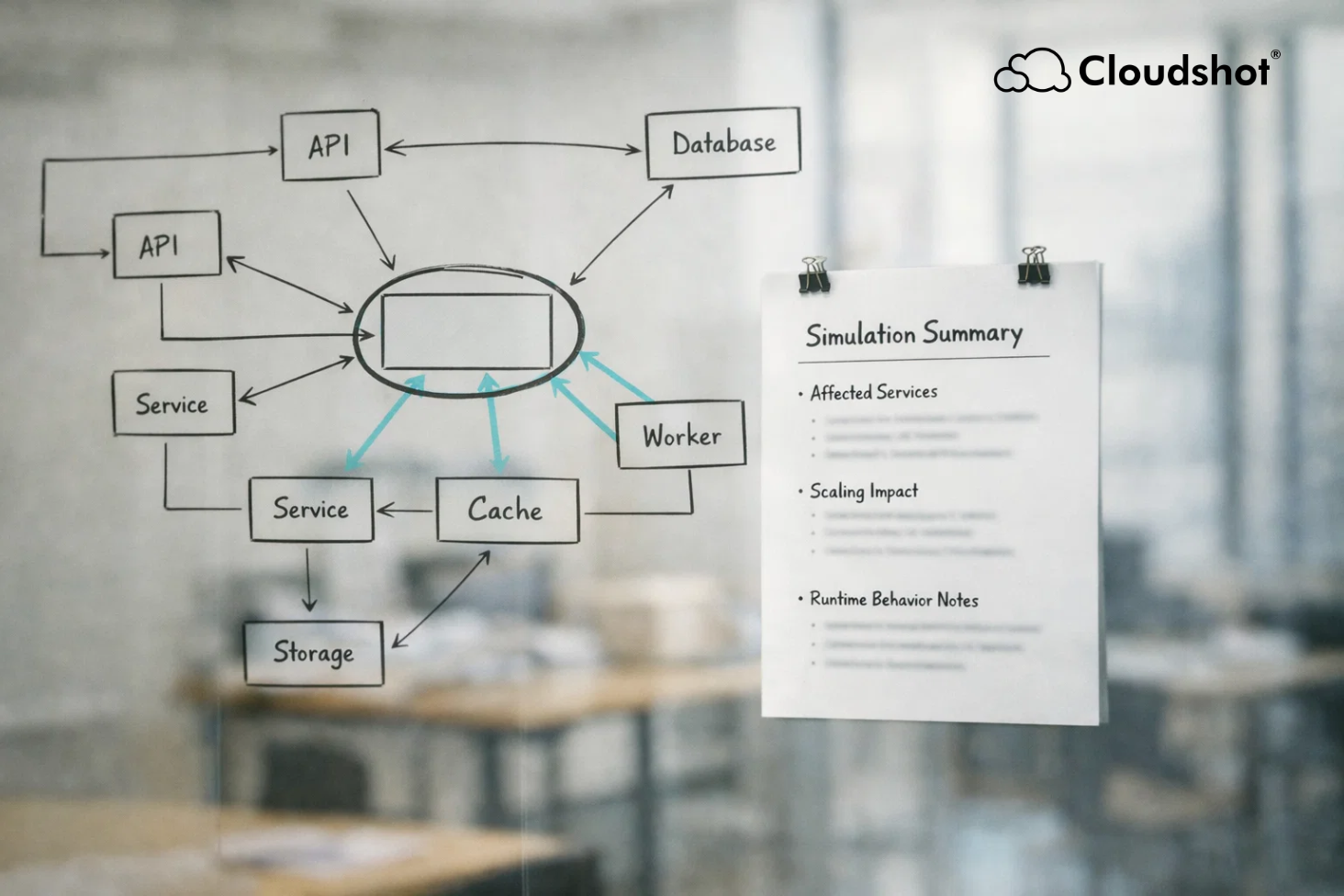
Cloudshot's Predictive Cost Simulation Guide introduces a practical workflow:
Select a proposed change.
Map its infrastructure dependencies.
Simulate runtime scaling patterns.
Project cost impact based on behavioral response.
Align ownership before approval.
This approach turns cost from a reactive audit function into a forward-looking engineering checkpoint.
It does not replace Finance oversight. It strengthens it.
A Practical Example
Consider a team deploying a new analytics service. The service appears lightweight. Resource requests look modest.
After deployment, traffic patterns trigger auto-scaling across related services. Cross-service calls increase. Data transfer costs rise quietly.
The invoice reflects not just the new service, but its ripple effect.
With predictive simulation, teams would have seen the expanded dependency footprint before merge.
Instead of debating responsibility, they would have aligned expectations in advance.
Cost Control as Shared Discipline
When engineering sees projected impact before deployment, cost becomes part of architectural thinking.
When Finance sees simulations before production, budget conversations shift from reactive to collaborative.
When leadership sees risk earlier, decision cycles shorten.
Cost governance becomes a design principle.
Not a postmortem.
Bringing It Together
Predictive cost simulation is not about restricting innovation.
It is about reducing surprise.
It keeps cost aligned with architecture.
It keeps teams aligned with each other.
And it moves cost control from reporting to decision.
If your organization reviews code, security, and performance before merge, cost deserves the same rigor.