Most production incidents don't start with bad decisions.
They start with reasonable changes interacting in ways no one fully anticipated.
A timeout is adjusted to improve resilience. A scaling rule is tuned for growth. A configuration change passes review and looks safe in isolation.
Nothing feels risky.
Until the change hits production.
Why Change Reviews Fail in Modern Cloud Systems
Traditional change reviews focus on intent.
What is being changed?
Why is it needed?
Does it pass validation?
What they rarely answer is the more important question:
How will the system behave once this change propagates?
In distributed cloud environments, behavior emerges through interaction.
A small adjustment in one service can:
shift load unexpectedly
amplify pressure downstream
change cost behavior before performance degrades
By the time these effects appear, teams are already reacting.
Logs don't exist yet.
Metrics haven't formed.
Alerts haven't fired.
So teams rely on experience and best guesses.
That approach doesn't scale.
Drift Forms Before Incidents Do
Many incidents aren't caused by the change itself.
They're caused by the drift the change introduces.
Dependencies respond differently than expected.
Traffic paths shift quietly.
Cost behavior changes without triggering alarms.
This drift accumulates invisibly until it crosses an impact threshold.
Production becomes the testing ground.
That's when teams wish they had seen the effects earlier.
Why "Wait and See" Is No Longer Acceptable
Modern cloud systems change too quickly for trial-and-error in production.
Even when rollbacks are possible, damage often happens before teams act:
users feel latency
budgets absorb spikes
confidence erodes
Prevention requires seeing impact before it's locked in.
What a Drift Sandbox Enables
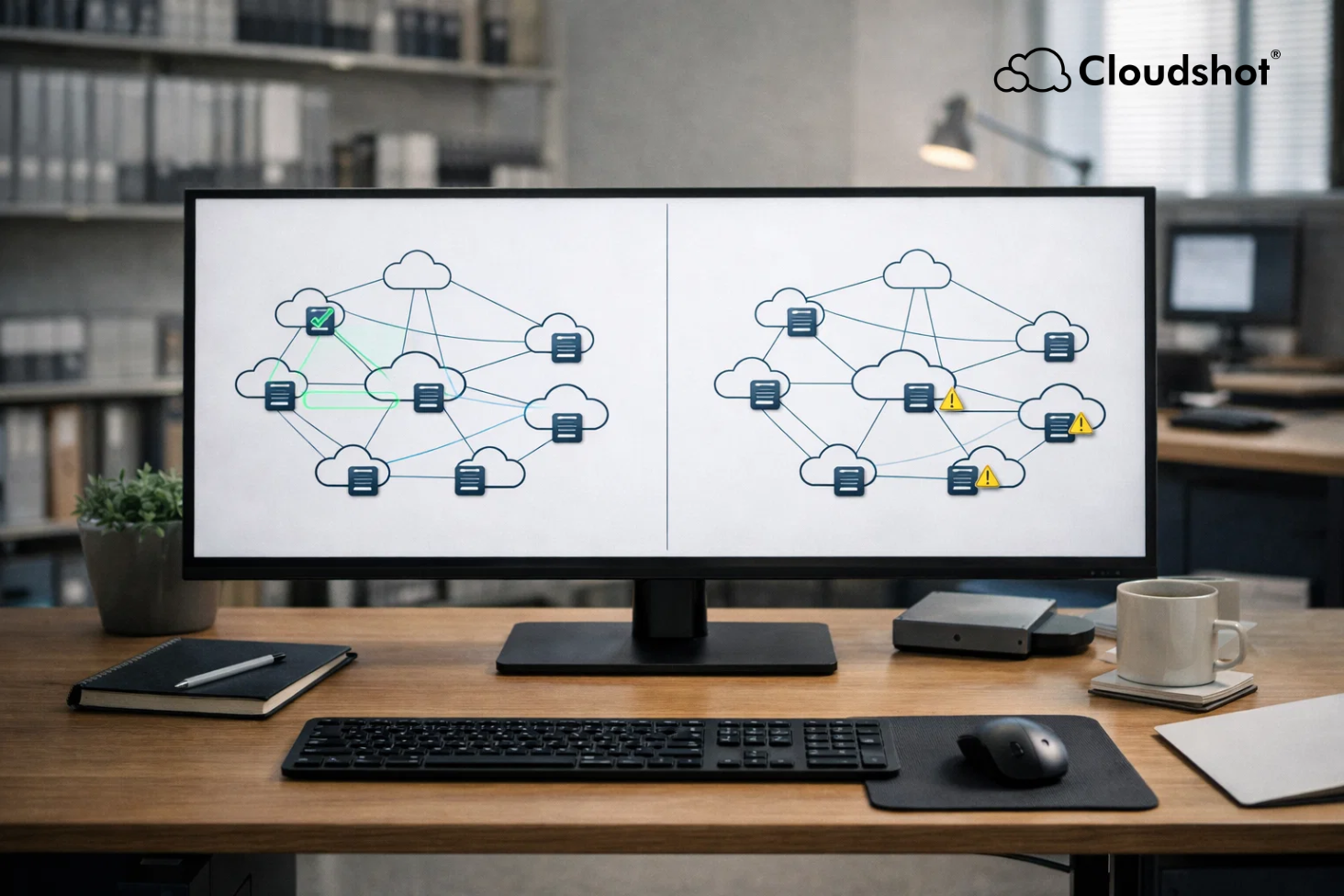
A drift sandbox allows teams to replay a planned change safely — before it ships.
Instead of speculating about outcomes, teams can observe them.
In a sandbox environment, architects and DevOps teams can:
apply the exact change they intend to ship
see how dependencies respond
identify unexpected interaction paths
observe cost deltas forming alongside behavior
This doesn't require perfect prediction.
It creates informed choice.
Teams move from "this should be fine" to "this behaves the way we expect."
From Experimentation to Intention
When impact is visible early, workflows change.
Change reviews become grounded in evidence.
Tradeoffs are discussed openly.
Risk is addressed deliberately.
Production stops being an experiment.
It becomes the final step of a decision already understood.
How Cloudshot Supports Safer Change Decisions
Cloudshot enables drift sandboxing by replaying planned changes against real architecture context.
Teams don't just see isolated components — they see how the system reacts as a whole.
Behavior shifts are visible.
Dependency reactions are clear.
Cost impact emerges alongside performance signals.
This gives teams time to adjust.
Not after users are affected. Not after budgets are hit.
Before production ever sees the change.