
Most cloud cost overruns don't begin with overspending.
They begin with uncertainty.
A pull request is opened to improve performance. Another adjusts autoscaling thresholds. A third introduces a new dependency to handle increased traffic. Each change feels reasonable in isolation. None are explicitly labeled as "expensive."
But cloud infrastructure does not behave in isolation.
Every deployment changes runtime behavior. Dependencies scale differently. Background jobs consume more memory. Storage I/O increases. Network traffic shifts. And while performance may improve, the invoice quietly expands.
By the time Finance detects a spike, the change has already been merged, deployed, and normalized.
This is the gap between engineering decisions and financial consequences.
The Real Problem: Cost Is Evaluated After Behavior, Not Before
In most organizations, cost visibility is retrospective.
FinOps teams analyze billing exports. They categorize spend. They attempt allocation across teams and projects. But the moment when cost is truly determined is earlier. It happens at deployment.
When a change modifies runtime behavior, cost trajectories shift immediately. But there is rarely a structured way to simulate that shift before merge.
So teams operate on assumptions:
"This won't scale much."
"It's just a minor tweak."
"The cost impact should be negligible."
Weeks later, those assumptions are tested against reality.
And reality sends an invoice.
The friction that follows is predictable.
Finance asks what changed.
Engineering searches commit histories.
Architects review scaling events.
Everyone reconstructs the past manually.
This is slow, reactive, and expensive.
A Different Approach: Cost Sandbox Before Merge
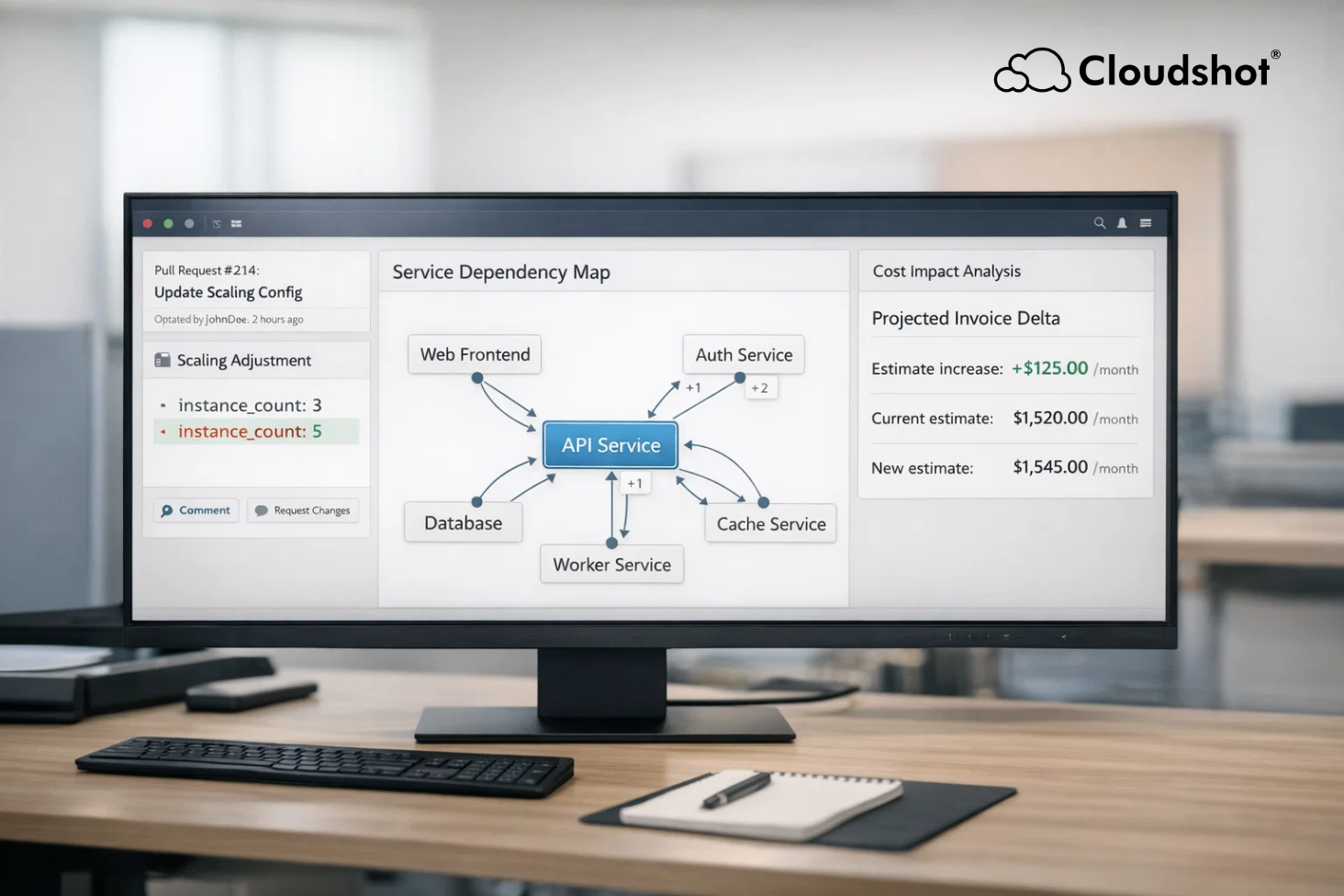
Cloudshot introduces a cost sandbox designed to move cost control earlier in the lifecycle.
Instead of waiting for billing data to reveal consequences, teams can simulate the impact of a deployment before it hits production.
The flow is simple:
Select a pull request.
Simulate runtime behavior under projected load.
Analyze dependency scaling.
View forecasted invoice delta tied to infrastructure changes.
This is not a static estimate based on instance type pricing. It is a behavior-aware projection.
Architects see how the change affects topology and downstream services.
FinOps sees the potential budget impact tied to ownership.
Engineering sees the cost implications of scaling decisions.
This transforms cost from a finance report into an engineering signal.
Why This Matters for FinOps and Architecture
FinOps maturity depends on shared responsibility. But shared responsibility requires shared foresight.
If engineers only see cost after deployment, they cannot optimize proactively.
If Finance only sees cost in aggregated billing exports, they cannot influence architecture decisions in time.
The cost sandbox bridges this divide.
It connects code to runtime behavior.
Runtime behavior to infrastructure scaling.
Infrastructure scaling to invoice projections.
Instead of debating historical spend, teams evaluate future impact.
That shift shortens feedback loops and reduces internal friction.
A Practical Scenario
Consider a SaaS team preparing a performance optimization release. A scaling threshold adjustment promises lower latency during peak hours.
In a traditional workflow, the team merges and monitors performance. Two billing cycles later, Finance detects a 12 percent infrastructure increase tied to expanded container counts and storage throughput.
With a cost sandbox, the same team runs a simulation before merge. The model shows projected invoice delta under expected traffic conditions. Architects adjust thresholds slightly to maintain performance without triggering unnecessary scaling.
The deployment ships. Performance improves. The budget remains stable.
No surprises. No post-mortems about cost.
From Reactive Accounting to Proactive Engineering
Cloud cost control is often treated as an accounting discipline.
But the root of cost behavior lives in architecture and deployment decisions.
By introducing pre-merge cost simulation, Cloudshot reframes FinOps as an engineering-integrated capability rather than a downstream reconciliation process.
This strengthens collaboration between CTOs, Architects, DevOps, and Finance leaders.
Because cost control should not rely on detecting anomalies after the fact.
It should be embedded where decisions are made.