This week, the cloud turned practical again.
Enterprises are asking sharper questions — not "how much AI can we use," but "how safely, how fast, and with whom."
From billion-dollar partnerships to AI adoption frameworks and open-source security scares, one pattern stands out: control is catching up to ambition.
Control is catching up to ambition.
🌩 This Week's 3 Signals
Google Cloud and Liberty Global Sign a 5-Year AI Partnership
Google Cloud struck a five-year deal with Liberty Global to embed Gemini-powered AI into network operations, cybersecurity, and customer experience across Europe.
Why it matters:
Enterprise AI is moving from pilot to production — this isn't about "testing use cases" anymore; it's about industrializing them.
Action to be taken: In Cloudshot, identify cross-functional AI workloads — tag where automation impacts reliability, compliance, and customer-facing systems. That's where the governance gap usually starts.
Microsoft Launches AI QuickStart to Accelerate Enterprise Deployment
Microsoft launched its AI QuickStart Program in Singapore, co-funded with IMDA and UOB, to help enterprises implement practical AI solutions faster and securely.
Why it matters:
Prescriptive programs like this define how AI gets operationalized. The future of AI adoption lies in structured frameworks, not ad-hoc integrations.
Action to be taken: In Cloudshot, run a value-per-workload simulation — model how time-to-adoption affects spend, efficiency, and compliance so you can justify scale decisions with real data.
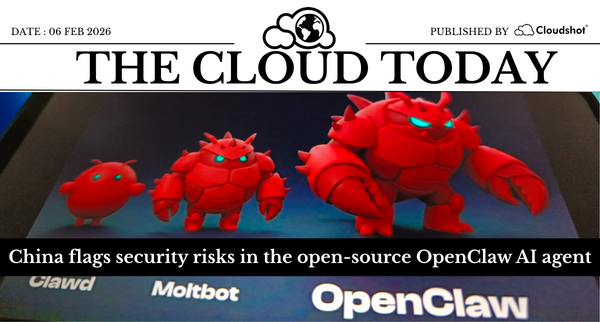
China Flags Security Risks in the Open-Source OpenClaw AI Agent
China's Ministry of Industry and Information Technology issued an advisory against OpenClaw, an open-source AI agent found leaking cloud credentials on Alibaba, Tencent, and Baidu Clouds.
Why it matters:
Open-source agents are becoming the next shadow infrastructure. The risk isn't from malicious code — it's from well-meaning teams deploying tools they can't fully audit.
Action to be taken: Use Cloudshot to map third-party agent activity inside your environments. Build automated flags when non-verified tools interact with IAM or storage APIs.
💡 Cloudshot Tip of the Week
Run a Preflight Governance Scan in Cloudshot before every release — it checks for access drift, unverified dependencies, and risky automation patterns.
Think of it as your "change-before-it-happens" safety net.
🗓 What We Published This Week
Feb 2 (Mon)
Silent autoscale costs — who pays when scaling misfires
What invisible scaling decisions do to budgets.
Feb 3 (Tue)
Decision fidelity: why observability needs provenance
Why tracing data lineage builds real trust.
Feb 4 (Wed)
Drift sandbox: replay a planned change safely before it hits prod
Simulate impact before your next outage.
Feb 5 (Thu)
Free Change-Preflight Checklist for Multi-Cloud Releases
Audit your change plan before your next deploy.
🔭 Strategic Signal
Every signal this week underscores one reality — the enterprise cloud is entering its accountability phase. AI alliances, structured adoption programs, and open-source risk management are redefining what "responsible cloud" means.
Visibility isn't optional anymore — it's competitive advantage.
⚠️ Before It Happens to You…
Make visibility a deliverable. Use Cloudshot to correlate AI adoption, automation risk, and governance gaps before your next major rollout.
Sums up updates in 2 mins reading here,
Saves hours of reading news.