
This week made one thing painfully obvious.
Cloud is no longer "just software." It is power contracts, geopolitical risk, and physical resilience.
If you are a CTO, your job just expanded. You now own availability across grids, regions, and real-world disruption.
🌩 This Week's 3 Signals
Big Tech signed a "ratepayer protection" pledge on data center power costs
Google, Microsoft, Amazon, Meta, Oracle, OpenAI, and xAI signed a pledge tied to keeping consumers from absorbing power infrastructure costs driven by AI data centers. The promise is essentially: we will fund the power we consume and upgrades needed, not push it downstream.
Why it matters
Power has officially become a board-level cloud constraint. Your scaling plan now depends on utility negotiations, grid upgrades, and local politics, not just instance limits.
Action to be taken
Build an energy dependency view of your architecture. Which critical workloads sit in regions likely to face grid stress or cost escalation. Treat it like a resiliency tier.
AWS flagged physical damage to UAE and Bahrain facilities from drone strikes
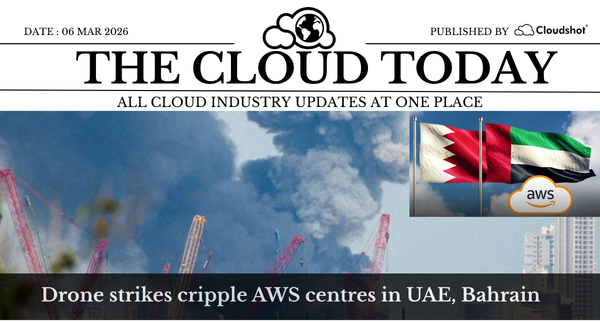
Reuters reported AWS said some data centers in the UAE and Bahrain suffered damage from drone strikes, causing service disruption and exposing the reality of regional concentration risk.
Why it matters
Multi-region is not the same as multi-risk. A conflict event can take out power, connectivity, and operations at once. That is a different failure mode than a normal outage.
Action to be taken
Run a geo-blast radius drill. Pick one region you rely on. Simulate loss of facility access plus degraded network plus delayed replacements. Document the true RTO and RPO, not the aspirational ones.
Amazon announced an additional €18B investment in Spain for data centers and AI
Amazon announced an additional 18B euros investment in Spain, taking total investment to 33.7B euros, positioning Spain as a major European capacity and AI hub over the long term.
Why it matters
Capacity is shifting to where power, permitting, and political support align. This affects future latency maps, workload placement, and even vendor leverage for EU-heavy footprints.
Action to be taken
Refresh your EU placement strategy. Identify which workloads should follow emerging power-ready hubs versus staying near existing customer clusters.
💡 Cloudshot Tip of the Week
Add a new control layer to your governance. Physical constraints.
In Cloudshot terms, treat power exposure and geopolitical exposure like first-class tags on your topology.
When an incident hits, you should see instantly which systems share the same physical risk, not just the same cloud account.
🗓 What We Published This Week
Mon
The Real Cost of Toolchain Sprawl in Multi-Cloud Teams
How fragmented tools create hidden delay, duplicated effort, and governance blind spots.
Tue
When Autoscaling Masks the Real Performance Problem
Why scaling up can hide root causes, inflate spend, and delay real fixes.
Wed
Live Dependency Mapping Across AWS, Azure, and GCP
A real-time view of cross-cloud dependencies so teams stop guessing during incidents.
Thu
FinOps for AI: How to Control AI Cloud Costs with Visibility
A practical approach to tracking AI spend by behavior, ownership, and impact, not just invoices.
🔭 Strategic Signal
The cloud industry is converging on a new reality. Reliability is no longer purely technical. It is financial, physical, and geopolitical.
CTOs who can connect change, cost, access, and region-level risk into one narrative will move faster.
Everyone else will keep arguing during incidents.
⚠️ Before it happens to you...
Do one thing this week. Pick your most business-critical region and document its real-world constraints. Power, legal, conflict, and supply chain.
If you cannot explain those constraints, you cannot defend your uptime.
Sums up updates in 2 mins reading here. Saves hours of reading news. Subscribe now.