
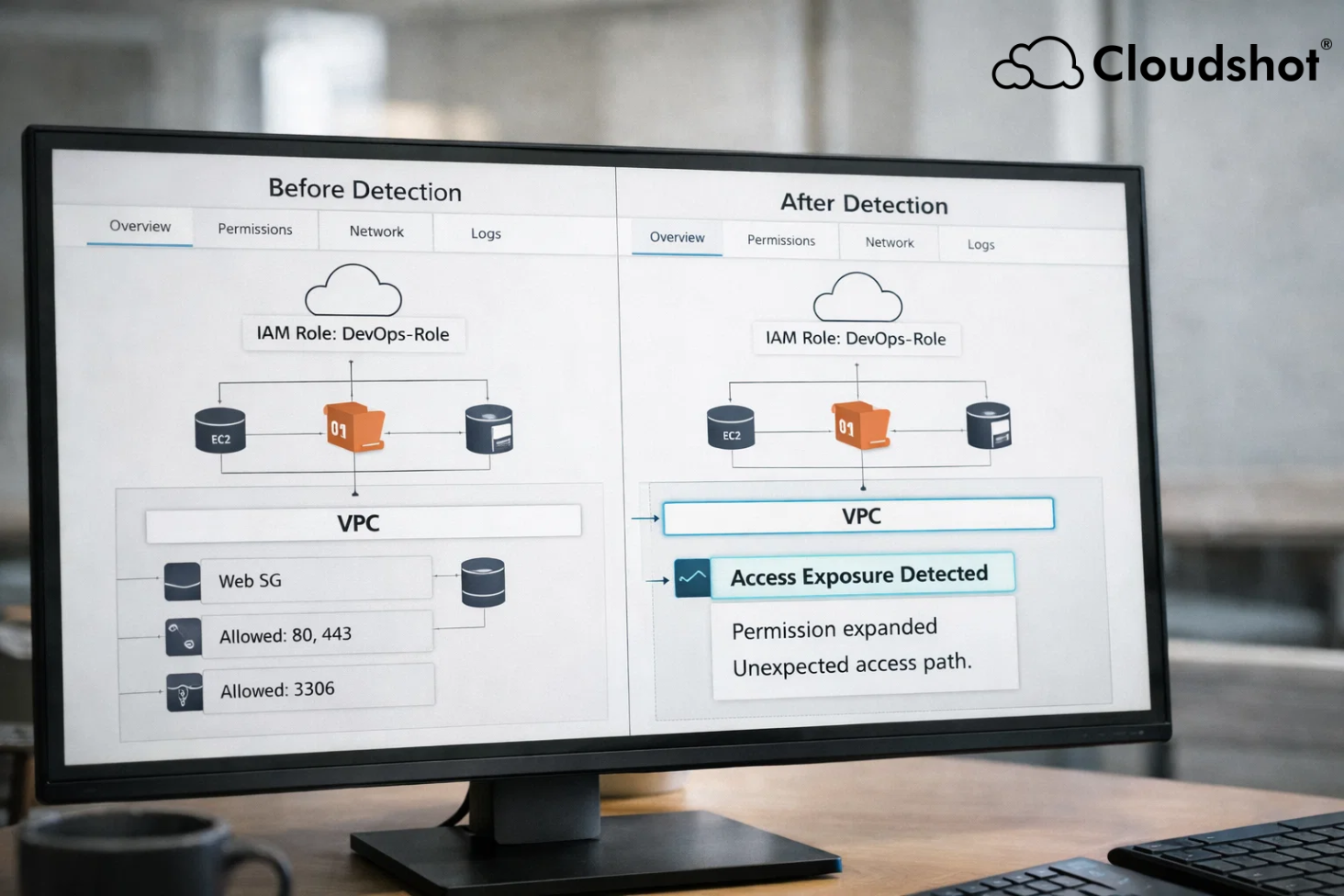
Cloud security is often framed as a detection problem.
Teams invest in tools that identify misconfigurations, policy violations, and access risks across infrastructure.
These tools are effective at finding issues.
But they often find them too late.
The Timing Problem in Cloud Security
In modern cloud environments, change is constant.
Developers deploy new services.
Infrastructure scales dynamically.
Permissions evolve as systems interact.
Each change has the potential to introduce risk.
Most of these changes are not malicious.
They are part of normal operations.
However, when security teams only discover these changes after they occur, the window of exposure has already opened.
The critical factor is not just detection. It is timing.
How Delayed Detection Creates Risk
Consider a common scenario.
An engineer updates an IAM policy to allow broader access during troubleshooting.
The change resolves an immediate issue.
But the expanded permission remains in place.
If detected immediately, the risk is minimal.
If discovered weeks later, the exposure becomes significant.
This pattern repeats across cloud environments:
Network rules temporarily opened
Services deployed with default configurations
Access permissions extended for convenience
Each instance creates a gap between change and detection. That gap defines risk.
Why Traditional Security Approaches Lag
Many security tools rely on periodic scanning or rule-based alerting.
Periodic scans review infrastructure at intervals.
Alert systems trigger when known violations occur.
Both approaches have limitations.
Scans provide snapshots, not continuous visibility.
Alerts depend on predefined rules, which may not capture every context.
As a result, security teams often operate in a reactive mode. They investigate issues after they are identified, rather than as they emerge.
The Need for Real-Time Change Awareness
Reducing exposure requires aligning detection speed with change velocity. Security teams must see infrastructure changes as they happen.
This includes:
Configuration updates
Permission changes
New resource creation
Dependency modifications
When these changes are visible in real time, teams can evaluate their impact immediately. This shifts security from reactive detection to proactive awareness.
Context Matters
Detecting a change is not enough.
Understanding its impact is equally important.
A permission change may affect a single service or propagate across multiple dependencies.
A network rule adjustment may expose an isolated resource or an entire application layer.
Without context, security teams must investigate manually.
With contextual visibility, impact becomes clear.
Cloudshot provides this by mapping changes onto infrastructure relationships. Security teams can see not only what changed, but how it affects the broader system.
From Detection to Prevention
When change awareness becomes immediate and contextual, security posture improves.
Teams can respond quickly.
Exposure windows shrink.
Misconfigurations are corrected before they become incidents.
Cloud security becomes less about finding problems later.
And more about understanding changes as they occur.
Closing the Gap
The challenge is not identifying misconfigurations.
It is identifying them in time.
Organizations that reduce the gap between change and detection reduce risk significantly.
Because in cloud environments, risk is rarely about what exists. It is about how long it exists unnoticed.