
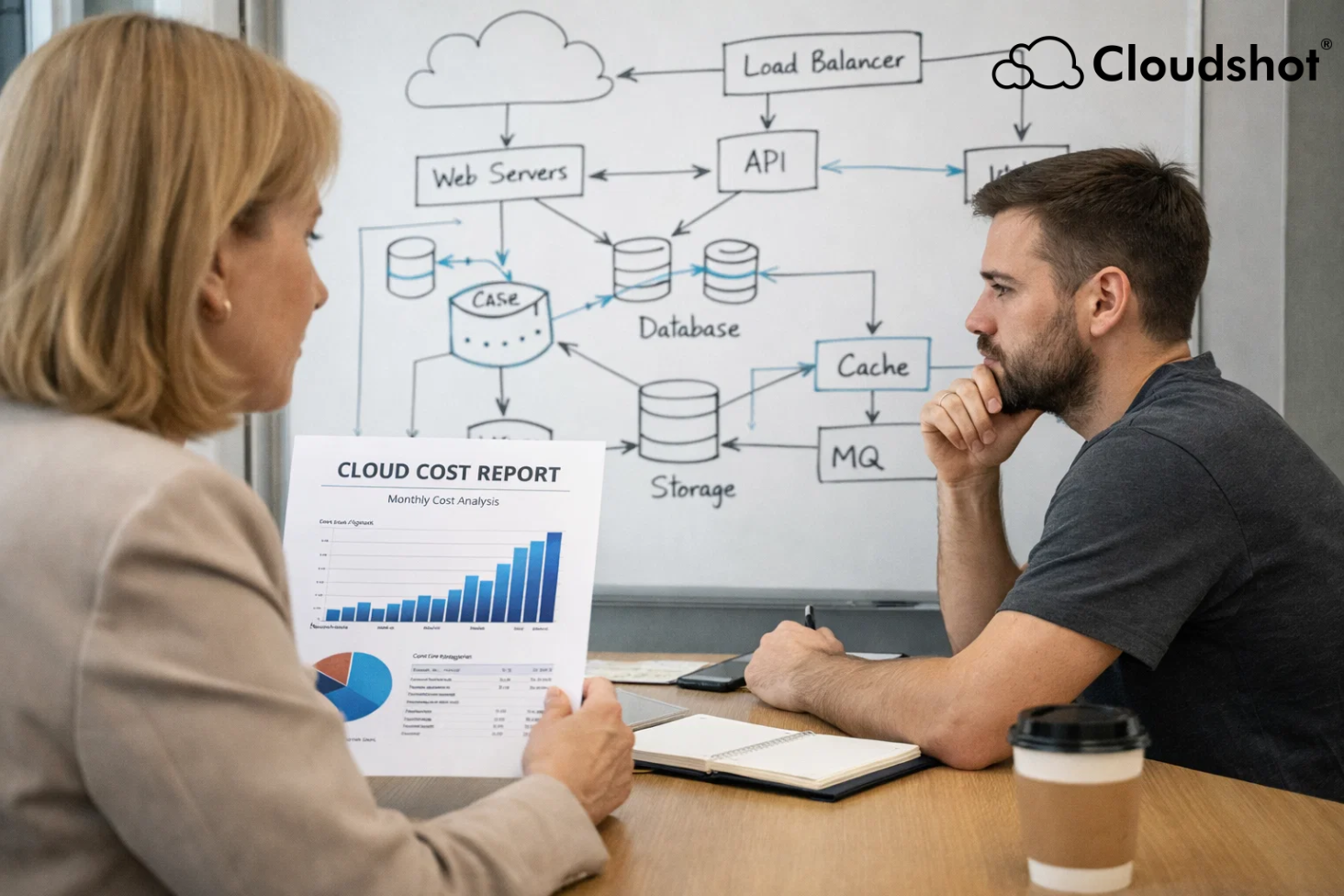
Cloud computing introduced a new financial model for infrastructure.
Organizations no longer purchase fixed hardware capacity. Instead, they pay for dynamic usage that scales with demand.
This model enables flexibility.
But it also introduces a transparency challenge between engineering and finance teams.
While engineering teams understand how systems behave operationally, finance teams often struggle to interpret cloud cost reports.
The result is a persistent trust gap.
The Finance Perspective
Finance teams expect cost reports to answer a fundamental question.
Why did spending change?
In traditional infrastructure models, cost fluctuations were relatively predictable. Hardware purchases were planned, and operational expenses followed stable patterns.
Cloud infrastructure behaves differently. Costs fluctuate based on:
Traffic volume
Infrastructure scaling
Service interactions
Deployment changes
A single architectural adjustment can alter usage patterns significantly.
However, most cost reports only present aggregated consumption metrics. They explain how much was used. They rarely explain why usage changed.
The Engineering Perspective
Engineering teams see cost behavior differently.
For them, changes in infrastructure usage often reflect normal operational dynamics.
A new deployment introduces additional service calls.
An autoscaling policy responds to higher demand.
A dependency processes more requests than before.
Each event makes sense technically.
But these technical events are rarely visible in cost reports. By the time finance reviews the invoice, the operational sequence behind the cost increase has already faded from memory.
The Missing Context Layer
The trust gap between finance and engineering exists because the two teams observe different signals.
Finance sees cost outcomes.
Engineering sees infrastructure behavior.
What's missing is the relationship between the two.
When cost spikes cannot be tied to a clear operational sequence, explanations become speculative. Engineering reconstructs events from logs and monitoring tools. Finance hears uncertainty. Confidence decreases.
Why Traditional Cost Tools Fall Short
Many cloud cost tools focus on allocation and categorization.
They help answer questions such as:
Which team owns this resource?
Which service consumed the most compute?
Which account generated the highest bill?
These insights are valuable.
But they still focus on cost distribution. They do not reveal the operational cause behind spending changes.
Without linking cost behavior to infrastructure events, cost reports remain incomplete narratives.
Connecting Behavior to Spend
True cost transparency requires connecting infrastructure behavior to financial outcomes.
When organizations can see how deployments, configuration changes, and service dependencies influence resource consumption, cost conversations change.
Instead of asking "Why is the bill higher?" teams can trace the sequence behind it.
A configuration change triggered increased traffic.
The traffic caused autoscaling.
Autoscaling increased compute usage.
Compute usage affected the invoice.
This behavioral chain transforms cost analysis from guesswork into explanation.
Aligning Finance and Engineering
FinOps aims to bridge this gap by encouraging collaboration between engineering and finance.
But collaboration alone is not enough.
Both teams need visibility into the same operational narrative.
When infrastructure behavior and cost signals appear together in a unified view, the conversation shifts.
Finance understands the drivers behind spending changes.
Engineering understands how operational decisions affect financial outcomes.
Trust improves. And cloud spending becomes easier to predict and manage.