
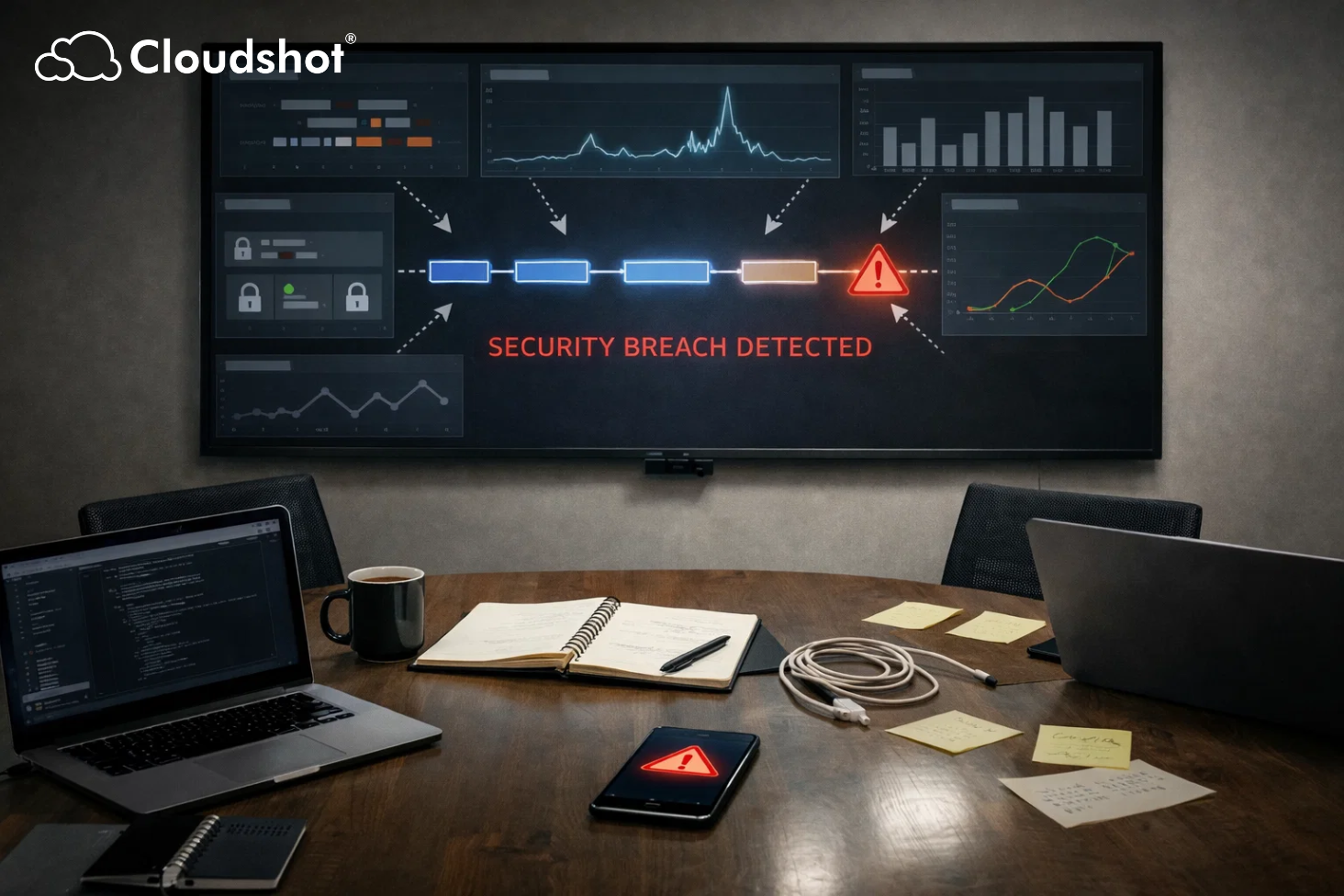
Root cause doesn't disappear during incidents.
Ownership does.
When something breaks, modern cloud teams don't lack effort. They lack a shared sequence of truth.
An alert fires. A service degrades. A bridge opens.
DevOps scans recent deployments.
SRE watches latency climb.
Security checks access changes.
Someone asks if traffic spiked.
Everyone is doing their job. No one owns the full story.
The Real Reason MTTR Keeps Growing
Most incident postmortems blame complexity. But complexity isn't the real culprit.
The real issue is handoff friction.
Cloud systems span teams, tools, and responsibilities. When incidents unfold, each group sees a slice of the problem through its own lens. Logs, metrics, and alerts provide fragments — not narrative.
So conversations sound familiar:
"Nothing changed on our side."
"It might be downstream."
"We need more data before we can say."
Ownership doesn't fail loudly. It fades quietly.
Fragmented Signals Create Fragmented Responsibility
Logs explain what happened at a component level.
Metrics show where pressure surfaced.
Tickets capture interpretations after the fact.
What none of these provide is sequence.
Without sequence, teams can't answer:
What changed first?
Which dependency reacted next?
Where did drift begin?
When did impact become inevitable?
Instead of alignment, teams debate timelines.
Instead of action, they negotiate responsibility.
This is how incidents stretch from minutes into hours.
Why Tooling Alone Doesn't Fix the Problem
Most organizations respond by adding more observability.
More dashboards.
More alerts.
More integrations.
But more data without shared context increases disagreement.
Each team brings "evidence" that supports its view. Decision-making slows, not because teams are unskilled, but because they don't agree on what actually happened.
Root-cause ownership evaporates when reality itself is contested.
The Missing Layer: Shared Incident Narratives
The fastest incident responses don't come from heroics. They come from shared understanding.
When teams see the same sequence of events, conversations change:
"This is where it started."
"This dependency reacted next."
"This is where we crossed into impact."
Ownership becomes obvious.
Not assigned. Not negotiated. Observed.
How Cloudshot Changes Incident Conversations
Cloudshot approaches incidents as stories, not signal collections.
Instead of stitching together logs after the fact, Cloudshot reconstructs the full change narrative:
configuration changes across teams
dependency reactions over time
drift formation before alerts fired
the moment behavior turned into impact
This narrative is shared across DevOps, SRE, Security, and leadership.
No one argues about whose data is correct. Everyone sees the same sequence.
That's when handoffs stop killing MTTR.
Prevention Starts Before the Next Alert
The real value isn't faster firefighting.
It's earlier recognition.
When teams understand how incidents form, they can spot drift while it's still reversible. Ownership returns upstream — before customers are affected.
Root cause doesn't need to be assigned. It becomes visible.