
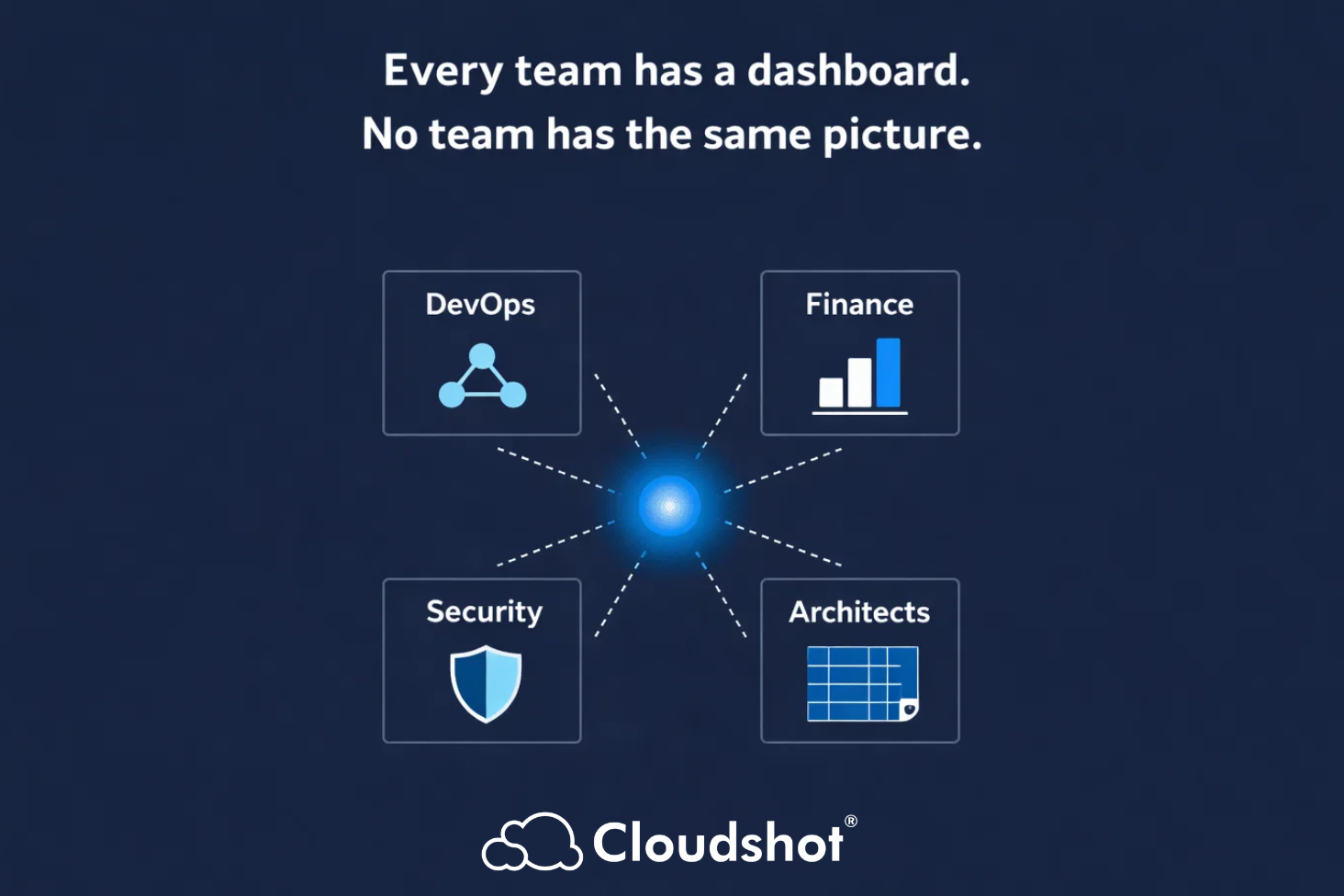
Most cloud teams believe they have visibility. DevOps has monitoring dashboards. Finance has billing reports. Security has audit logs. Architects have infrastructure diagrams.
But ask all three teams the same question - what is actually running in our cloud right now, and who owns it - and you will get three different answers.
That is not a tooling problem. It is a visibility architecture problem. Each team is looking at a different slice of the same infrastructure, updated at different intervals, structured around different questions. The gap between those slices is where incidents escalate, budgets overrun, and audits get uncomfortable.
Here is where it breaks per role - and what to do about it.
DevOps: Fragmented Visibility Costs Response Time
When the pager fires at 3 AM, the question is not whether something is broken. The alert answered that. The question is what changed, when, and who owns it. That is the question most monitoring tools cannot answer.
Monitoring tracks symptoms. It does not track causality. When Terraform state does not match production, every incident starts with a debate instead of a diagnosis. MTTR climbs not because tools are slow - but because every bridge call starts with six people and six different theories.
Three steps to fix it:
Track live infrastructure state separately from declared IaC state - drift between the two is where incidents hide
Auto-tag every resource with the deploying team at provisioning - ownership should never be a question during an outage
Alert on drift before deployment, not after the incident
Finance: Fragmented Visibility Costs Accountability
Cloud billing data arrives 30 days after the spend. By the time Finance opens the invoice, the decision that caused the overrun has already been made and the team responsible has moved on.
Even with billing data, it is structured around services - not teams. Answering "which team owns this spend" requires cross-referencing against tagging data. And tagging in most multi-cloud environments is inconsistent at best.
One company connecting to Cloudshot for the first time found 31% of monthly cloud spend was untagged.
Finance ran a 3-day manual reconciliation every month just to attribute it. Engineering spent those same 3 days fielding interruptions.
Three steps to fix it:
Enforce a tagging schema at provisioning - every resource mapped to a team, service, and cost center before it runs
Run an untagged resource report weekly, not when the invoice arrives
Give Finance a live cost view by team - not a static export from the billing console
Security: Fragmented Visibility Costs Continuity
Security visibility usually means point-in-time snapshots - audit logs, IAM policy reviews, access control documentation. The problem is that cloud environments do not hold still between reviews.
IAM drift does not trigger an alert. A role created in 2021 gets cloned during onboarding. Three services deployed in Q3 inherit permissions from that role. By Q4, the blast radius of one compromised account has quietly tripled - and the last audit showed nothing because it was taken before those deployments happened.
Passing the audit is not the same as being secure.
Three steps to fix it:
Review inherited permissions every time a new service is deployed - not just at quarterly audit cycles
Map every IAM role to what it actually touches in production, not what the policy document says
Flag any role unreviewed in 90 days as a drift risk - don't wait for the auditor to find it
Cloud Architects: Fragmented Visibility Costs Accuracy
Architecture diagrams describe intent, not reality. The moment a diagram is published, the live environment starts to diverge from it. Services get added. Resources move. Configuration changes accumulate.
One team three weeks into a planned 6-week migration discovered 17 services not in any documentation - some running for over 14 months with no clear owner.
The migration ran over schedule not for technical reasons, but because nobody had a live picture of what was actually deployed.
Three steps to fix it:
Treat architecture diagrams as live outputs of actual infra state - not a one-time design artifact
Run a full resource discovery scan before every migration, not during it
Assign an owner to every service at provisioning - no owner means no accountability
The Pattern Across Every Role
Every team has a dashboard. No team has the same picture.
DevOps cannot see cost.
Finance cannot see ownership.
Security cannot see drift.
Architects cannot see what is actually deployed.
Adding another tool for each gap does not fix the problem - it adds another slice to an already fragmented picture.
The fix is one live map that all four teams work from.
Every resource tagged to a team.
Every cost attributed to a service.
Every IAM role mapped to the access it actually grants.
Every change visible in context, with ownership attached, updated continuously.
Cloudshot maps every resource across AWS, Azure, and GCP into a single live topology.
Tag accuracy from 74% to 99%.
Audit time from 3 days to 2 hours.
$22,000 per month in zombie workloads identified and shut down in the first week.
The cloud did not get simpler.
The visibility architecture did.
If your teams are working from different versions of your cloud, see what one live map looks like in your environment.