The quarterly IAM review finished on a Friday afternoon.
The report was clean. Findings were documented. Remediation tickets were opened. The security team moved on.
By the following Wednesday, three new services had been deployed. Each one inherited permissions from existing roles. Two engineers changed teams. Their access was not updated. A policy was modified during a Tuesday incident and never reverted.
The next quarterly review was 89 days away.
This is not an edge case. This is the standard operating model for IAM governance in most multi-cloud environments. And it is exactly how drift accumulates between the reviews designed to catch it.
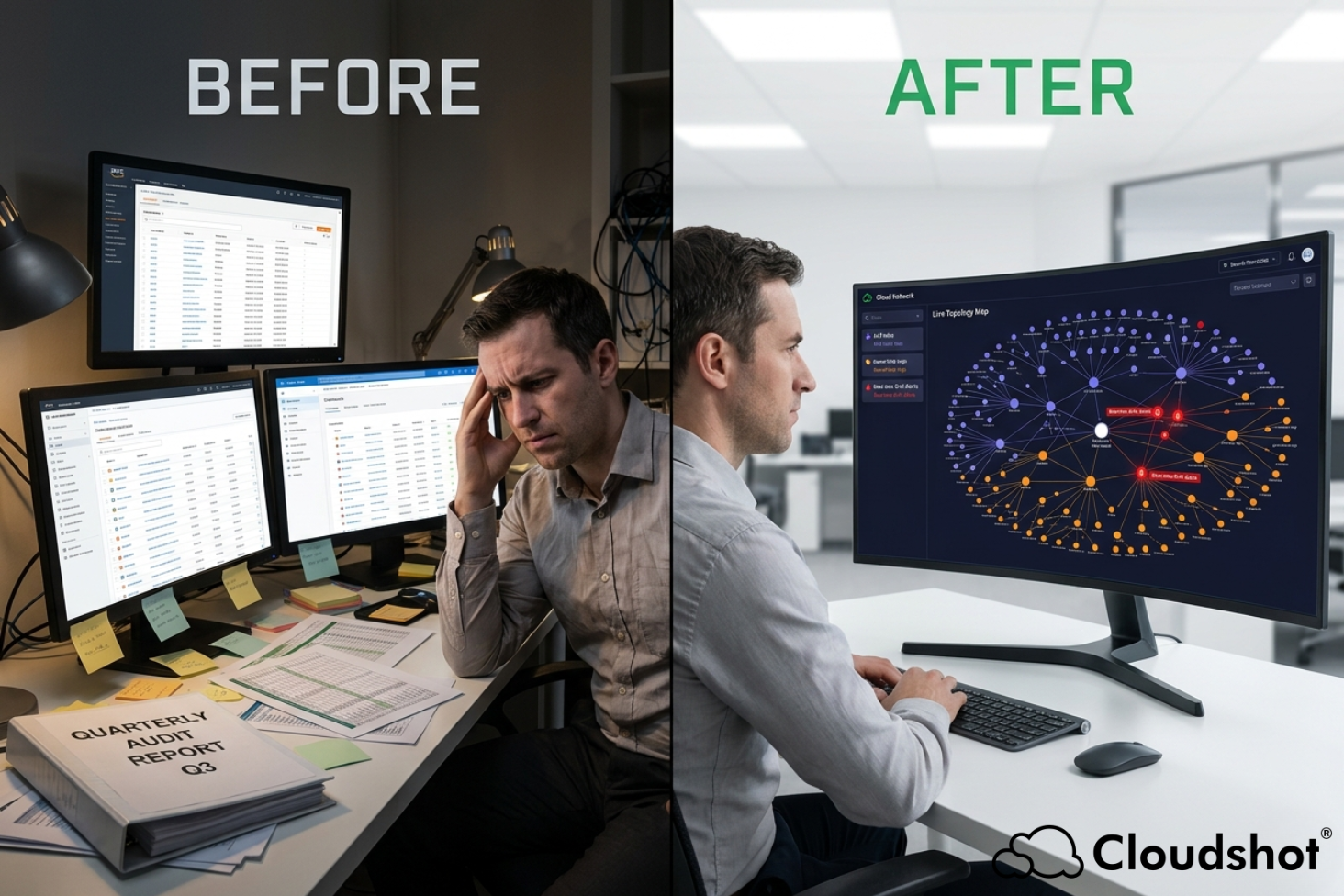
The Before State: Point-in-Time Reviews Against a Continuously Drifting Environment
Most teams manage IAM access the same way. A review runs quarterly. It covers each cloud separately. Findings are exported to a spreadsheet, triaged by severity, and assigned to engineers who are already managing incident queues and deployment schedules.
The process is not broken. It is just too slow for the environment it is trying to govern.
In a multi-cloud environment running across AWS, Azure, and GCP, IAM state changes constantly. New services get deployed. Roles get cloned from templates. Cross-account permissions get added during incidents as temporary fixes. Service accounts accumulate long after the projects they were created for have closed.
None of this waits for a quarterly review cycle. The environment drifts continuously. The review catches a snapshot of where things stood on one specific day. Everything that changed after that day is ungoverned until the next snapshot.
The three gaps every team faces before they have real-time IAM visibility are consistent:
No unified view across all cloud providers simultaneously. AWS, Azure, and GCP each have their own access model, their own policy format, and their own audit trail. Reviewing them separately means cross-account inheritance chains, which span all three, are rarely mapped in full.
No real-time signal when a permission changes between reviews. A role that drifts on a Wednesday does not surface until the next quarterly report. By then, it has been live for 89 days, through two sprint cycles, one incident, and a compliance deadline.
No ownership metadata connecting findings to teams. When an IAM finding surfaces with no attributed owner and no review history, remediation becomes a conversation about who to call first. That conversation takes longer than the fix.
What Happens When Drift Goes Undetected
The consequences of undetected IAM drift are not theoretical.
One team passed a compliance audit in Q2. The audit covered every active IAM role, every policy binding, and every cross-account permission. The report came back clean. The team moved on.
By Q4, a security researcher found a misconfigured S3 bucket that had been publicly accessible since before the audit closed. The configuration had drifted after the review. A new service deployment had modified the bucket policy as part of its setup. The change was never flagged. The bucket sat open through two sprint cycles, one major product release, and a board-level security review.
The audit tool never flagged it because the audit tool reviewed point-in-time state. The drift happened after the point. Nobody was watching the time between.
This is how compliance and security diverge. Passing a compliance review means the environment met a specific set of criteria on a specific day. It says nothing about what the environment looks like 72 hours later. IAM drift exploits exactly that gap.
The After State: Continuous Visibility Against Live Architecture
The teams that stay ahead of IAM drift share one practice. They treat access as a live architecture problem, not a compliance checkpoint.
This means three things change fundamentally.
Every IAM role, every policy binding, and every cross-account permission is visible in one unified view across all cloud providers simultaneously. Not per cloud. Not per team. One map that shows the full permission landscape against the live infrastructure it governs. When a cross-account inheritance chain spans AWS and GCP, it is visible as a single connected picture, not as two separate reports that need to be manually reconciled.
Every change to IAM state surfaces in real time. A permission added on a Tuesday is visible on Tuesday. A role that inherits elevated access through a cloned template is flagged the moment the clone is created. Drift does not accumulate between reviews because the review is continuous. Every change is an event. Every event is tracked.
Every role and every finding carries ownership metadata. When drift surfaces, the owning team is already identified. The path from detection to remediation is a direct line, not a conversation about accountability.
What the Numbers Look Like After
The shift from point-in-time reviews to continuous IAM visibility produces measurable outcomes across every team metric that matters to security and finance.
One team using Cloudshot improved IAM attribution accuracy from 74% to 99%.
Audit preparation time dropped from three days to two hours.
Cross-account permissions across AWS and Azure were mapped in full within one hour of setup.
The next compliance review required no manual spreadsheet reconciliation.
None of those outcomes required additional security headcount. They came from changing when the team saw IAM state, from quarterly to continuous, and from changing what they saw, from per-cloud snapshots to a unified cross-cloud map.
The team that passed Q2's audit and found the S3 bucket in Q4 did not lack a security process. They lacked visibility between the process checkpoints. That is the gap continuous IAM monitoring closes.
Cloudshot Maps IAM Drift in Real Time Across AWS, Azure, and GCP
Cloudshot gives security teams a live visual map of every IAM role, every policy, and every cross-account permission across AWS, Azure, and GCP. Policy drift surfaces the moment it occurs. Cross-account inheritance chains are visible as connected architecture, not as separate per-cloud lists. Every finding comes with an owner, a change history, and the live infrastructure context that makes remediation fast.
When a new service deploys and inherits permissions that exceed its scope, Cloudshot flags it before the next audit cycle. When a cross-account permission is added during an incident, it is tracked before it becomes permanent infrastructure. When a role drifts from its original purpose, the owning team sees it on the same day, not 89 days later.
Your IAM environment is not static. Your review process should not be either.
Book a 1:1 demo at cloudshot.io/demo/?r=ofp and see what your full IAM picture looks like when access is visible in real time across all three clouds.