
Cloud tagging was designed to bring order to cloud environments.
Add labels to resources.
Track costs.
Organize infrastructure.
Environment = Prod
App = CRM
Cost Center = 1234
At a small scale, it works.
At real scale, it breaks.
🚨 The Problem Isn't Tagging. It's Accuracy.
Most teams rely on tagging for:
Application-level cost tracking
Environment-based reporting
Cost center allocation for finance
Ownership and governance
On dashboards, everything looks structured.
But that structure often hides a deeper issue.
Tags are rarely accurate.
Not because teams don't care.
Because infrastructure changes faster than tags do.
A VM gets reused.
A service changes ownership.
A workload shifts environments.
The tag stays the same.
Over time, reporting diverges from reality.
⚠️ Why Tagging Breaks in Real Environments
1. Manual tagging doesn't scale
As infrastructure grows, tagging becomes a memory problem.
DevOps teams are expected to apply and maintain tags across hundreds or thousands of resources.
Consistency drops quickly.
2. Tag drift is inevitable
Even correctly tagged resources become outdated.
Infrastructure evolves continuously.
Tags remain static.
This creates silent errors in reporting.
3. Bulk updates are painful
Fixing tags should be easy.
It isn't.
Most cloud providers don't offer clean bulk update workflows.
Teams rely on scripts or manual fixes.
Which rarely happen consistently.
4. Finance depends on broken inputs
FinOps teams trust tags for reporting.
But inaccurate tags lead to misleading cost allocation.
This creates friction between engineering and finance.
🧠 The Core Issue: Static Labels vs Dynamic Systems
Cloud environments are dynamic.
Resources scale.
Dependencies shift.
Ownership changes.
Tags are static.
That mismatch is the root problem.
Without continuous alignment, tagging becomes unreliable.
🔍 How Cloudshot Solves the Tagging Problem
Cloudshot takes a different approach.
Instead of relying only on manual tagging, it aligns tagging with real infrastructure behavior.
This allows teams to:
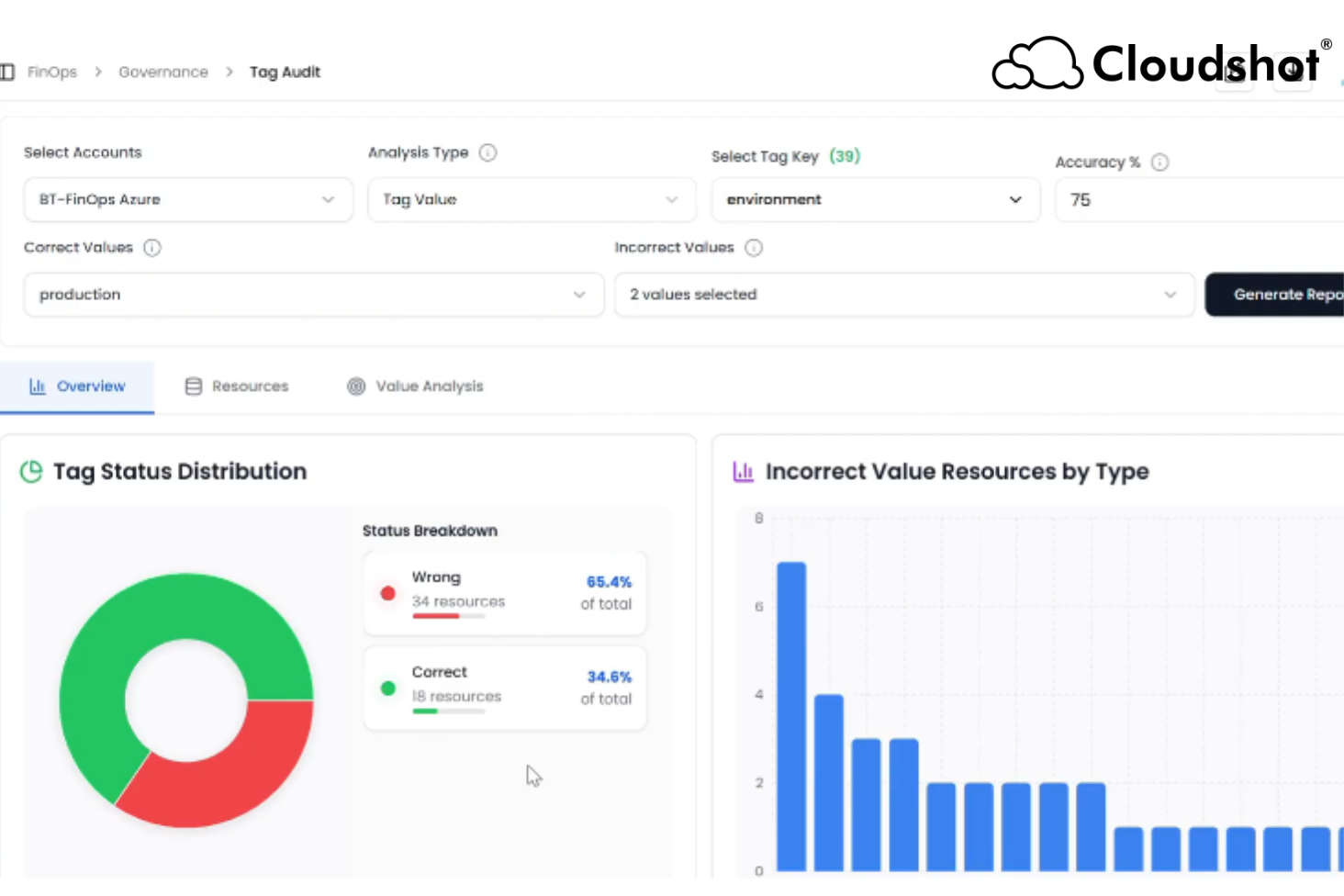
Identify missing or incorrect tags instantly
Understand how resources actually relate to applications
Maintain tagging accuracy without constant manual effort
👉 Learn more about improving cloud visibility and tagging accuracy: cloudshot.io
Instead of guessing, teams work with reality.
⚙️ Bulk Tagging Without DevOps Overhead
One of the biggest operational challenges is updating tags at scale.
Cloudshot simplifies this.
Teams can:
Apply tagging logic across multiple resources
Standardize tags across environments
Eliminate repetitive manual corrections
This saves significant DevOps time.
And reduces operational friction.
💰 Aligning Engineering and Finance
When tagging improves, conversations change.
Finance sees reliable cost allocation.
Engineering trusts the reporting layer.
Both teams operate on the same truth.
Not conflicting interpretations.
📊 From Tagging to True Visibility
Tagging was meant to create clarity.
At scale, it often creates confusion.
Cloudshot shifts the model:
From static tags → to dynamic context
From manual maintenance → to automated alignment
From inaccurate reporting → to trusted visibility
🎥 See the Problem and Solution in Action
Watch how Cloudshot solves tagging challenges in real environments:
🚀 Final Takeaway
Tagging is not broken.
Manual tagging is.
As cloud environments scale, relying on static labels becomes unsustainable.
Teams need systems that evolve with infrastructure.
Cloudshot delivers that.